
What to Do With 10,000 Travel Photos You Never Look At
Your travel photos aren't disorganized — they're invisible. Here's what to actually do with the thousands sitting untouched on your phone.


What to Do With 10,000 Travel Photos You Never Look At
Some travelers open their camera roll, see "3,412 items" from a two-week trip, feel something between guilt and exhaustion, and close it again. That's the whole story of modern travel photos. We take more than ever and look at them less than ever.
If you've searched for what to do with travel photos, you've probably been handed the same advice on every list: back them up, sort them into folders, buy more cloud storage, make an album "when you have time." I followed all of it for years. My photos are backed up in three places. I still never looked at them.
Here's what finally worked, and why the standard advice quietly fails.
The short answer
Stop organizing them. Start giving yourself a reason to open them.
Storage was never the problem. Your photos are safe — probably backed up across a phone, a laptop, and at least one cloud you're paying for. They're not messy either; your phone already sorts them by date, face, and location automatically. The problem is that none of that makes you look. A perfectly organized archive you never open is still a dead archive.
So the real task isn't sorting 10,000 photos. It's building one small thing you'll return to — and letting the other 9,700 photos stay exactly where they are, safe and ignored.
Why "I'll sort them later" never happens
The barrier isn't laziness or time. It's scale.
Ten thousand photos isn't a to-do item, it's a wall. The moment you open the folder to "finally deal with it," the sheer size of the thing pushes you back out. So you close it, promise yourself a free weekend, and that weekend never comes. This is the single most common pattern I hear from other travelers: not "my photos are a mess," but "it's just too overwhelming to start."
Notice the reframe. Overwhelmed is not disorganized. You don't fix overwhelmed by organizing harder — that's more of the thing that scared you off in the first place. You fix it by shrinking the job until it's small enough to finish in one sitting.
Most of your photos were never meant to be kept
Here's the freeing part. Of a two-week trip's 3,000 photos, maybe 30 carry the memory.
The rest are duplicates (you took five of the same sunset to be safe), blurry frames, screenshots of train times, a photo of a menu, the "just in case" shots. They did their job in the moment. They don't need a permanent home, and they definitely don't need sorting. The goal was never to curate all 10,000. It's to rescue the 2–3% that mean something and put those somewhere you'll see them.
A rough rule that works: 20 to 40 photos per trip. Enough to tell the story, few enough that you'll never dread opening it.
Organize by place, not by date
This is the shift that changes everything, and it's the one thing your phone gets wrong.
Phones file memories by date because dates are easy for computers. But no one remembers their life in timestamps. You don't think "October 2023." You think that week in Lisbon — the tiled staircase, the tiny place with the grilled fish, getting lost near the castle. Memory is built around places, not calendars.
When you ask people to sort their own travel photos with no instructions, almost all of them do the same thing without thinking: they group by country and city. It's the natural filing system of the human brain, applied to travel. Working with that instinct instead of against it is why "by place" feels effortless while "by date" always feels like homework.
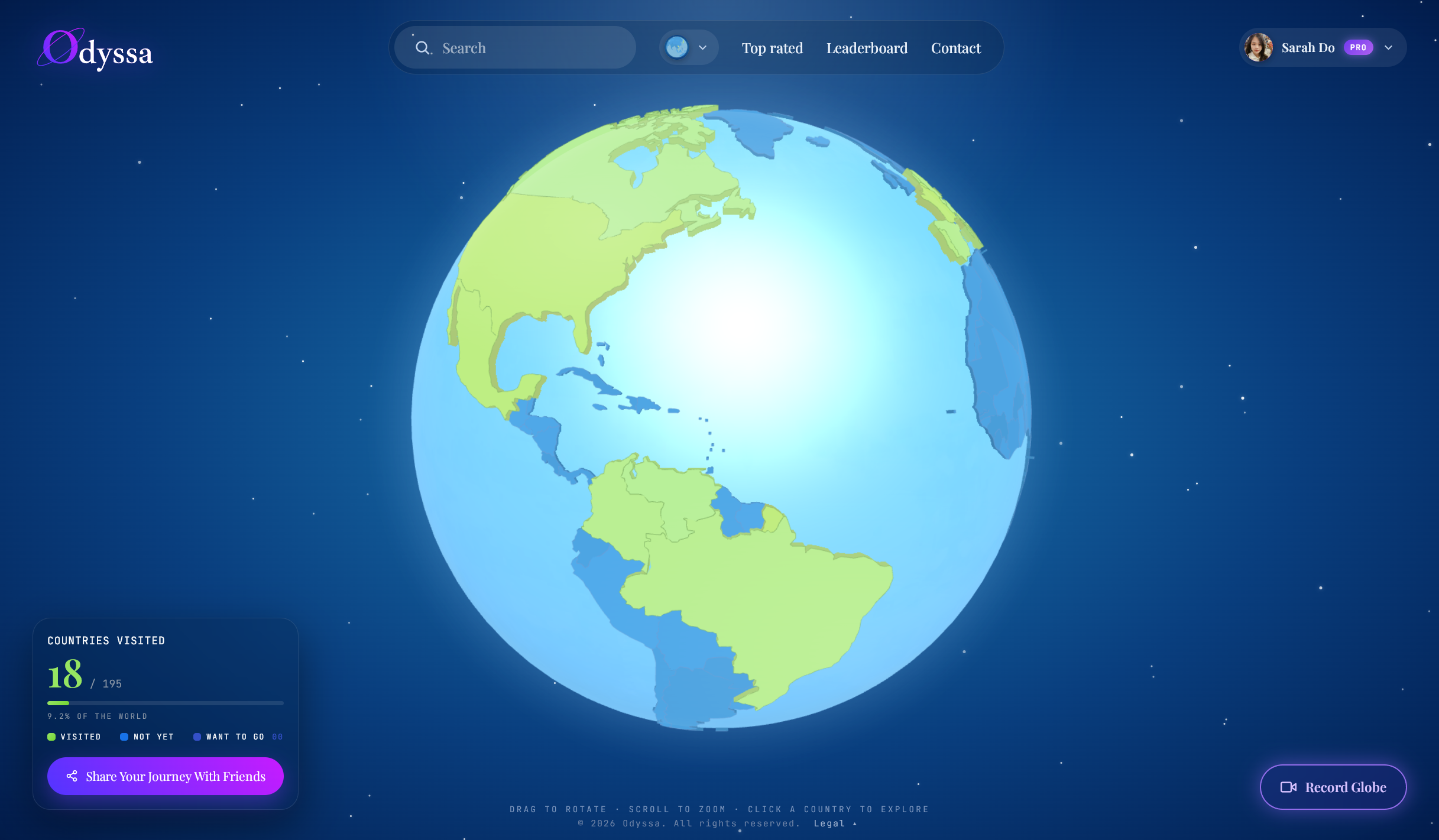
I ended up putting mine on a 3D map — one country at a time, with only the handful of photos that mattered attached to each. It took about ten minutes to set up the first few countries, and for the first time in years I open the thing on purpose. If you want to try it, you can build one free at odyssa.me — mark a country, drop in your best few photos, done.
A workflow that takes an afternoon, not a weekend
You don't need a system. You need a small, finishable ritual. Here's the whole thing:
- Pick one trip. Not all of them. The most recent, or the one you loved most.
- Set a 20-minute timer. Scroll that trip once, fast. Favorite only the photos that make you feel something. Don't overthink — your gut is faster and better than your judgment here.
- Stop at ~30. If you've favorited 80, you're keeping "good photos," not "memory photos." Be ruthless. You're rescuing the story, not building a portfolio.
- Give them a home by place. Group those 30 under the city or country — a map, an album per country, a folder simply named "Lisbon." Whatever you'll actually reopen.
- Leave the other 2,970 alone. They stay backed up, untouched, forever. That's not failure. That's the point.
Do one trip today. You'll have done more with your photos in 20 minutes than in the last three years of "someday."
The thing that actually makes you look back
Every so-called photo problem is the same problem underneath: there's no reason to return.
A backup exists so nothing is lost. It's insurance — and you don't reread your insurance policy for fun. What's missing is a trigger: something that makes reliving a trip feel inviting instead of like a chore. That's why organizing by place works so well. A map of everywhere you've been isn't a filing system, it's a reason. You open it to see the shape of your own life, and the photos come along for the ride.
A folder is where photos go to be safe. A map is where they go to be seen.
If your camera roll has become a graveyard of trips you loved and never revisit, that's the fix — not more storage, not a tidier folder tree. Rescue the best 30 from each trip, put them somewhere built for looking rather than storing, and let the rest rest in peace.
FAQ
What should I do with thousands of old travel photos? Don't try to organize all of them. Keep the best 20–40 per trip, group those by place, and put them somewhere you'll revisit. Leave the rest backed up and untouched — you almost certainly won't miss them.
Is it better to organize travel photos by date or location? By location. Phones default to date because it's easy for software, but people remember trips by place. Grouping by country or city matches how memory works and makes photos far more likely to get looked at again.
How do I stop feeling overwhelmed by my camera roll? Shrink the job. You're not sorting 10,000 photos — you're rescuing ~30 from one trip in a single 20-minute sitting. Overwhelm comes from scale, so make the task small enough to finish.
Where can I put travel photos so I actually look at them? Anywhere built for revisiting rather than storing — a place-based album, or a travel map where each country holds its best few photos. The format matters less than one rule: it has to give you a reason to open it. A 3D travel map like Odyssa is one option built specifically for this.